Articles by Tag #arduino
Browse our collection of articles on various topics related to IT technologies. Dive in and explore something new!


How to write Arduino Uno code with Python?
Recently I came across a Reddit thread where someone asked: "I was thinking about using an Arduino,...


EEPROM 28C64 API Performance with Arduino
Read and write operations are dominated by Arduino execution overhead, roughly 120 ns per digital pin operation. Active polling of the EEPROM `READY/BUSY` pin significantly reduces write times, cutting wait from 1400 µs to 600 µs without errors. Sequential write/read tests confirm reliable data transfer, while excessive speed risks corrupting writes. Future work includes testing chip endurance, data retention, and performance across different Arduino clock speeds.


🔐 Control a Solenoid Lock with Arduino Mega (Using a Relay & Push Button)
Introduction Welcome back, makers! 👋 If you enjoyed building Wi-Fi-controlled LEDs, let’s...


Understanding the Arduino IDE build process
Have you tried Arduino and already built your first sketch with a single click? Or maybe you’re just...


Drive 16 (or More) LEDs with Two 74HC595 Shift Registers Using Only 3 Arduino Pins
Why this project? Arduino boards run out of GPIO pins fast when you start doing LED patterns or...


Build a Smart Object Detection Alarm with Arduino & HC-SR04 Sensor – Full Tutorial
Introduction In this hands-on project, we successfully designed and built a smart object...


How to Send ESP32 Sensor Data to Miniviz for Real-time Visualization(Miniviz #1)
What is Miniviz? Miniviz is a BI platform developed for individuals to accelerate IoT PoC...


TM1637 Board Arduino Example
The TM1637 is a 8 segments led controller which can control up to 6 displays and key scan of 16...


Building a Precise Real-Time Clock with Arduino and DS3231MZ+
Hey, developer friends! Have you ever gotten fed up with timekeeping in your Arduino projects always...

🚀 Uploading Your Code with Arduino IDE
Introduction Welcome back to our IoT journey! 👋 In the previous post , we installed the...

Testing embedded projects: automate builds and simulate execution with Github Actions and Wokwi simulator
Testing embedded projects often turns into a slow, manual routine—compile locally, flash hardware,...

Why using arduino-cli is better than building from Arduino IDE
Detailed version of this article is published on EmbeddedK8. Did you know you don’t need the Arduino...


IoT Architectures Under Pressure: Smart Thermostat, an Example (Part 5)
In a previous post, we explored why designing a smart device can be more complex (and costly) than...


Wemos D1 Mini w/ Waveshare e-Paper 2.13 HAT
AI flat-out lied to me several times while trying to get this working, so now I guess I'm giving AI...


EEPROM Data Storage Using I2C With Arduino UNO And AT24C256 Module
In the fast-evolving world of embedded systems, one of the most critical challenges is ensuring data...


Arduino IDE Configuration for ESP32-C3 DevKitM-1 / Rust-1
Quick reference for board settings and a working blink + Serial sketch using ESP32C3 Dev Module.

EEPROM Read and Write Operations with Arduino
Explored EEPROM 28C64 basics using Arduino. Built a simple API to hide low-level pin control. Verified read/write operations, though some datasheet waveforms don’t match practice. Used breadboard, button, and LCD for control and display. Performance, timing accuracy, and data retention issues remain for future study.


ESP32 Thermal Printer Tutorial – Print Receipt, Barcode, and QR code
Thermal printer technology has revolutionised receipt printing in retail, healthcare, and IoT...
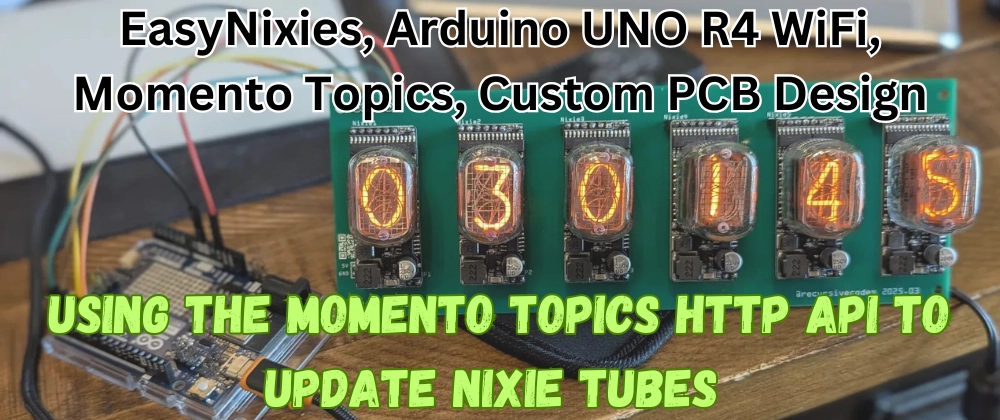

Using the Momento Topics HTTP API to Update Nixie Tubes
Tinkering with hardware projects is one of my absolute favorite hobbies. Of course I love to write...


Automating Arduino Library Deployment with GitHub Actions: Version Validation, Pull Requests, and Release Automation
Introduction Managing Arduino libraries can be a daunting task, especially when it comes...


DIY Telegram-Controlled ESP32 Security Cam
🛡️ Smart Home Security with ESP32‑CAM & Telegram Bot A DIY surveillance project that...

Build Your CAN Bus Skills: A Beginner’s Guide to Using CAN in Your Projects
In this article, we’ll dive into the CAN (Controller Area Network) Bus protocol by building a...


Matter protocol on a budget
A Thread border router is not mandatory to interact with Matter devices Matter is a “super-standard”...


How to use VS Code to develop Arduino
Using VS Code for Arduino Development offers better code management, debugging, and extensions...


Ulanzi TC001 - ESP32 Programming / Custom Arduino firmware
I found quite a lot of tutorials on using the Ulanzi TC001 with a firmware like AWTRIX, but not much...


Building a Traffic Light Simulator with a Countdown using Arduino and a 7-Segment Display
Introduction After blinking your first LED on Arduino, what's next? Before moving on to...


Digging Deeper: LED Blink from Arduino, C, and AVR Assembly
Intro I've been learning electronics and microcontrollers. I've decided to pick the AVR...


Building a Security System, with motion detection and time based settings using Arduino
Home security is a priority in the modern world and setting up a personalized do it yourself motion...


GSoC 2025 - Week 8: Designing Serial Port Component and Real Hardware Demo
Week 8 began with our second meeting with Prof. Gargi Khanna, joined by my mentor Aman Asrani. We...

What is the role of the bootloader in Arduino? Why is the Bootloader Needed?
The bootloader in Arduino is a small but critical piece of firmware that enables easy programming and...